A machine on the road
One cool Saturday morning, I shaved, put on a navy suit, polished my shoes, and drove to a Tesla dealership in Rockville, Maryland. To everyone around me I was simply another customer interested in the new Model Y. I had come for something else entirely: to interrogate a machine.
For years I had watched governments debate artificial intelligence, politicians arguing over regulation, economists over jobs, while one question went unanswered in my own mind. How does a machine make decisions that resemble human judgement? The only way to find out, I decided, was to let one drive me.
Minutes into the test drive, the advisor pressed a small button and the steering wheel began to move on its own. The car slowed before an intersection and stopped smoothly at a red light. A pedestrian stepped toward the crossing, and before I had even thought to brake, the vehicle had already decided to wait.
When another car drifted into our lane, the Tesla adjusted without drama, smoothly, almost elegantly. Had I been driving, I might have reacted with a jolt of alarm. The Tesla reacted mathematically.
The car was not intelligent because it had memorised every road in America; it was intelligent because it had learned, from millions of examples, to see, to predict, and to decide. Behind the dashboard, no one was steering; instead, millions of tiny artificial units were working at once, each performing one almost trivial task, and together they produced perception, prediction, and action. I had just watched the closest thing we have yet built to an artificial brain.
What AI really replaces
Yet the drive left me with a conviction, not a fear. However far these machines advance, they have never decided history on their own. The steam engine, electricity, the internet, each widened what was possible, but people, institutions, and leadership decided what became of it.
Artificial intelligence is no different. It creates possibilities; leadership determines outcomes. Take a smaller, humbler story.
For years our embassy in Washington relied on a gifted graphic designer named Derick, who lived in Nairobi. Every poster became a relay race across time zones: someone drafted the message, another approved it, then it went to Derick, and we waited. “Just a few small changes,” the Ambassador would say, a bigger title, the flag moved slightly, “celebration” changed to “commemoration” and then, on reflection, back again.
Each revision meant another email, another night’s wait, another invoice. One afternoon, out of curiosity, I typed the very same instructions into an AI design tool. Before my coffee had cooled, four polished versions sat on the screen.
People told me AI had replaced Derick. It had not. Derick was as gifted as ever; he still understood emotion, culture, symbol, and story in ways no machine truly grasps.
What AI had replaced was not the designer. It was the waiting. AI rarely walks into an office and announces, “You’re fired.” It quietly changes the economics of work, and whether that becomes unemployment or opportunity is decided not by the machine, but by us.
I have also lived the other side of that story. I am a Certified Public Accountant and a diplomat; I hold no computer-science degree and, until recently, had never written a line of code. Yet by working patiently alongside AI, describing what I needed, testing what it produced, correcting it, asking again, I built a full digital operating system for my embassy in about six weeks, working part-time.
I call it EDOS, the Embassy Digital Operating System. It coordinates the core work of a mission under one roof, consular services and diaspora management, the economic and political affairs desk, finance, human resources, and
AI rarely walks into an office and announces, “You’re fired.” It quietly changes the economics of work.
EDOS
Embassy Digital Operating System
Judgement, justice and responsibility
the Ambassador’s own engagements, and it is powered by AI agents that carry out analysis and draft the reports on which decisions are made. The machine did not replace me. It did the opposite: it lent its speed to a purpose only I, inside the institution, fully understood.
The value was never in the code the machine supplied, nor even in the reports the agents now draft, but in knowing what to build and why, and that remained, stubbornly and valuably, human. History has seen this before. When the automated teller machine arrived, everyone assumed bank clerks were finished.
Instead their numbers rose for forty years, because banks used the savings to open more branches, before falling later, once other choices were made. The same machine produced opposite results in different eras. It was never the author of the teller’s fortunes.
Human decisions were. Unemployment, wherever it appears in this era, will not have been imposed by technology. It will have been permitted, or prevented, by policy.
For all its fluency, a machine can process knowledge but cannot exercise judgement; it can recommend, but it cannot accept responsibility. Nowhere is that clearer than in a courtroom, where AI can transcribe hearings, translate between Kiswahili and English, and clear backlogs, yet cannot weigh evidence or temper law with mercy. An algorithm may assist a judge; it must never become one.
And the machine can be confidently wrong, the industry politely calls it “hallucination,” offering elegant arguments built on authorities that do not exist. Confidence is not accuracy, and accuracy alone is not justice. The deepest lesson, though, came from a boy.
The ferry to Kamanga sits low in the water and moves without hurry, and on the afternoon I am thinking of, Lake Victoria was so still it might have been poured from glass. I had left my home village of Karumo, in the Sengerema District of Mwanza, and was crossing toward the city on the far shore. Around me the passengers had settled into the small silences of travel, a trader
The deepest lesson came from a boy.
When AI changes the meaning of education
counting his notes, two women laughing softly, a boy watching the wake unspool behind us. To pass the time, I telephoned my teenage nephew. We traded the usual greetings, and then, without warning, the conversation turned.
“Uncle,” he said, with all the certainty of youth, “there is really no reason to struggle with studying any more.” I was caught off guard, and asked why. His answer came without a pause: “Because of AI. We have ChatGPT now.
It can answer almost anything. Why spend years studying when a machine can do it in seconds?” For a while I said nothing, and only watched the light move on the water. It would have been easy to dismiss the remark as a boy’s shortcut around his homework.
But his words carried something far larger, a belief now spreading quietly through a whole generation, from Mwanza to Manila: that artificial intelligence has become a replacement for learning rather than a reason to learn more. And as the far shore slowly gathered shape, a harder question began to trouble me. If a generation comes to believe that education is pointless because a machine will always supply the answer, what becomes of curiosity?
What becomes of the patience to wrestle with a hard problem, of judgement, of conscience, of the capacity to lead? The problem, I understood then, was not ChatGPT. The machine had never told my nephew to stop learning; no technology had pronounced education obsolete.
What had quietly shifted was our sense of what education is for. It was never, at its heart, about storing answers, a task at which the machine now plainly beats us. It was always about learning to ask a better question, to weigh evidence, to find a way through an unfamiliar problem, to decide well, and then to carry the weight of that decision.
A machine can generate information without end; it cannot supply judgement, or character, or responsibility, or vision. Those a person must still grow for themselves. By the time the hull nudged the jetty at Kamanga, a single sentence had settled in my mind and refused to leave.
01Artificial intelligence does not remove the need for education, it raises the standard of what education must achieve.
Artificial intelligence does not remove the need for education, it raises the standard of what education must achieve. The great test of this era was never the cleverness of the machine. It is whether we can still teach a people to think, to use the machine wisely rather than kneel before it.
Our schools were built to produce workers who follow procedures reliably, precisely what machines now do at almost no cost. Reform must move us toward what stays human: the capacity to think critically, to solve unfamiliar problems, to create, and to direct the machines rather than imitate them. I did not learn that from a policy paper.
I learned it as a student. There is a Swahili proverb I have come to understand better in the past two years than in all the years before them: mtaka cha uvunguni sharti ainame, whoever wants what lies under the bed must first bend down for it. I am a Certified Public Accountant and a diplomat, yet I enrolled, with rather more confidence than the situation warranted, in a postgraduate programme in artificial intelligence and machine learning at the University of Texas at Austin.
It is the very training that lets me build things like EDOS. I carried no background in computer science into that classroom, and I felt the difference at once. My classmates were a mixed company: seasoned software engineers for whom the vocabulary was a mother tongue, and others, like me, who had come from business, from law, from medicine, from public service.
The lectures did not slow for the beginners, and the assignments slowed for no one. Problems an engineer beside me dispatched in a single evening cost me long nights, reading a concept three times before it would hold, rebuilding what I had broken, asking for help I had once been too proud to ask for. That, I slowly came to see, was the whole lesson, the one lying beneath the syllabus.
The gap between the engineer and me was real, but it was not permanent; patience, and a willingness to bend down, could close it. In the age of artificial intelligence no qualification is ever finished, and no one, not the accountant, not the diplomat, not the minister, is exempt from beginning again. If a nation is to build a culture
Whoever wants what lies under the bed must first bend down for it.
Tanzania’s opportunity
It cannot import a prepared people.
of lifelong learning, its leaders will have to model it, and to model it is to be willing, now and then, to be the slowest person in the room. A nation can import machines. It cannot import a prepared people.
That, it must grow for itself. Here caution turns to ambition. Tanzania need not build the fastest processor, we never will, and need not.
Our advantages lie elsewhere: the world’s youngest population, a deep well of entrepreneurial talent, and a language spoken by more than 200 million people across the continent. A Kiswahili-speaking Africa is not a market to be served by others; it is a technology waiting to be built at home. The machine will keep learning, faster than any of us can.
What it cannot do is choose what kind of society it is built to serve. That asks of us not a better machine but better leadership, the foresight to invest beyond one’s own tenure, the courage to make hard choices, the inclusion to reach the rural school and the informal worker, and the responsibility to refuse to hide behind the machine when it fails. The growing must begin now, while the generation that will inherit this economy is still sitting in our classrooms.
The machine decides nothing. We do.
A Kiswahili-speaking Africa is a technology waiting to be built at home.
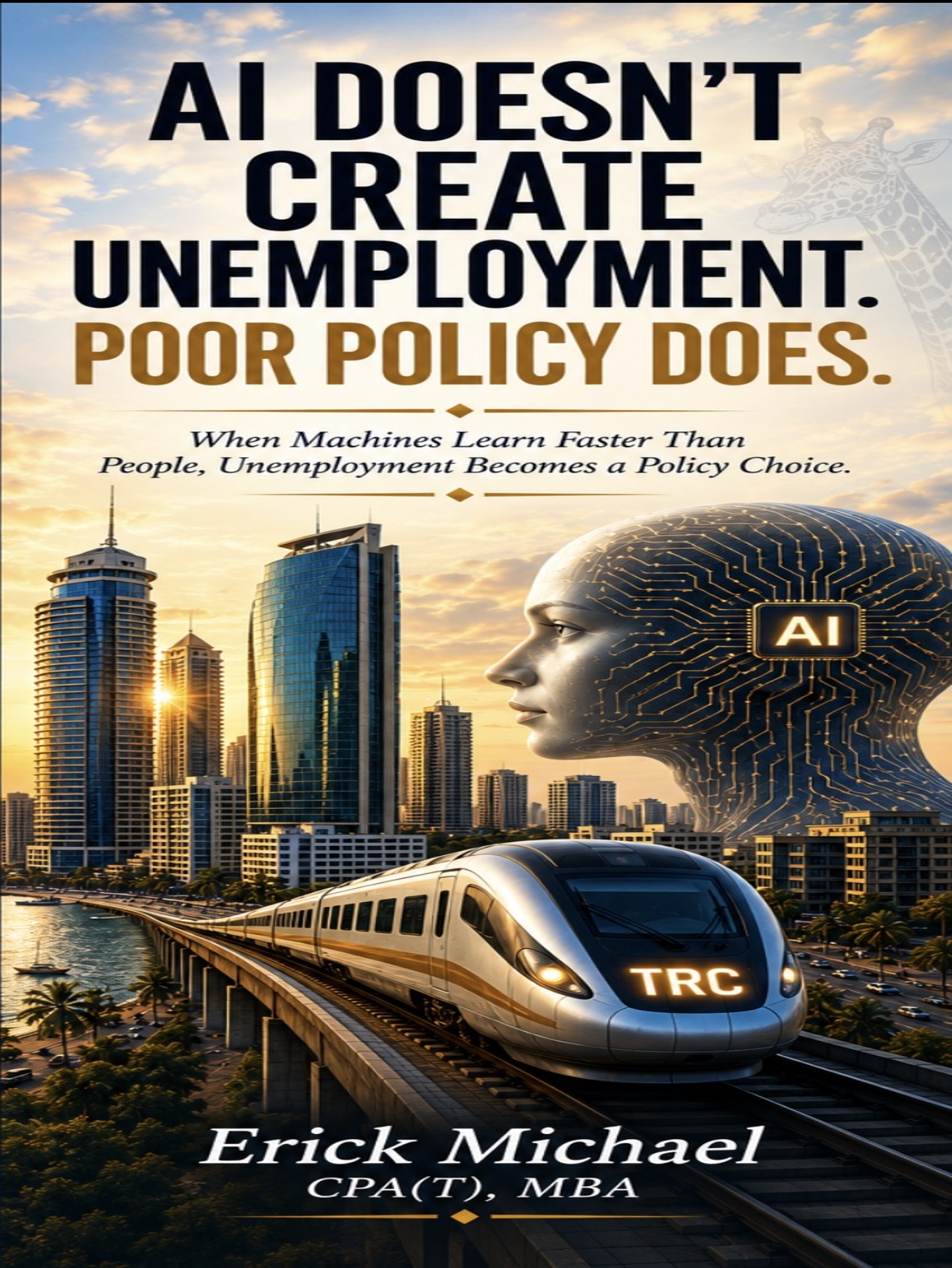
Continue the argument in the book.
“AI Doesn’t Create Unemployment. Poor Policy Does.” expands this essay into a full account, with a national strategy and a ten-year roadmap. Technology creates possibilities; leadership determines outcomes.
Erick Michael, CPA(T), MBA
Erick Michael, CPA(T), MBA, is a Tanzanian diplomat and Certified Public Accountant serving as Financial Attaché at the Embassy of the United Republic of Tanzania in Washington, D.C. He is the author of AI Doesn’t Create Unemployment. Poor Policy Does.
The views expressed are the author’s own and do not necessarily represent those of the Government of the United Republic of Tanzania or any affiliated institution. For syndication or interview requests, contact the author.